
Find the friction before adding more motion.
Most growing companies do not need more initiatives. They need to understand which part of their operating system is preventing strategy from moving.
Surfingvest Diagnosis gives leadership an independent operating read before committing more time, capital or organisational energy to the next move.
An important move still requires a better answer.
Diagnosis is useful when leadership knows that the company must move, but does not yet have enough clarity to commit resources with confidence.
You do not need to arrive with the answer. Diagnosis exists to formulate and resolve the right question before the next move.
Read the movement. Find the friction. Connect the pain.
Diagnosis connects what the company is trying to achieve with the operating conditions preventing it from happening consistently and the symptoms appearing in daily execution.
Momentum
The movement the company is trying to create.
Growth, expansion, transformation, professionalisation or another important strategic move.
Business Frictions
The operating conditions preventing Momentum from becoming consistent execution.
Misalignment, dependencies, unclear ownership, weak coordination or insufficient capacity.
Tactical Pains
The visible symptoms appearing in day-to-day execution.
Delays, margin erosion, rework, overload, low conversion or dependence on key people.
Momentum tells us where the company wants to go. Business Frictions reveal what is holding it back. Tactical Pains show where the pressure appears.
Nine operating dimensions. Four form the structural spine.
We assess the business through nine connected operating dimensions. Strategy, Marketing, Operations and Finance form the structural spine. Technology, Customer Experience, Legal, People and Sales complete the system.
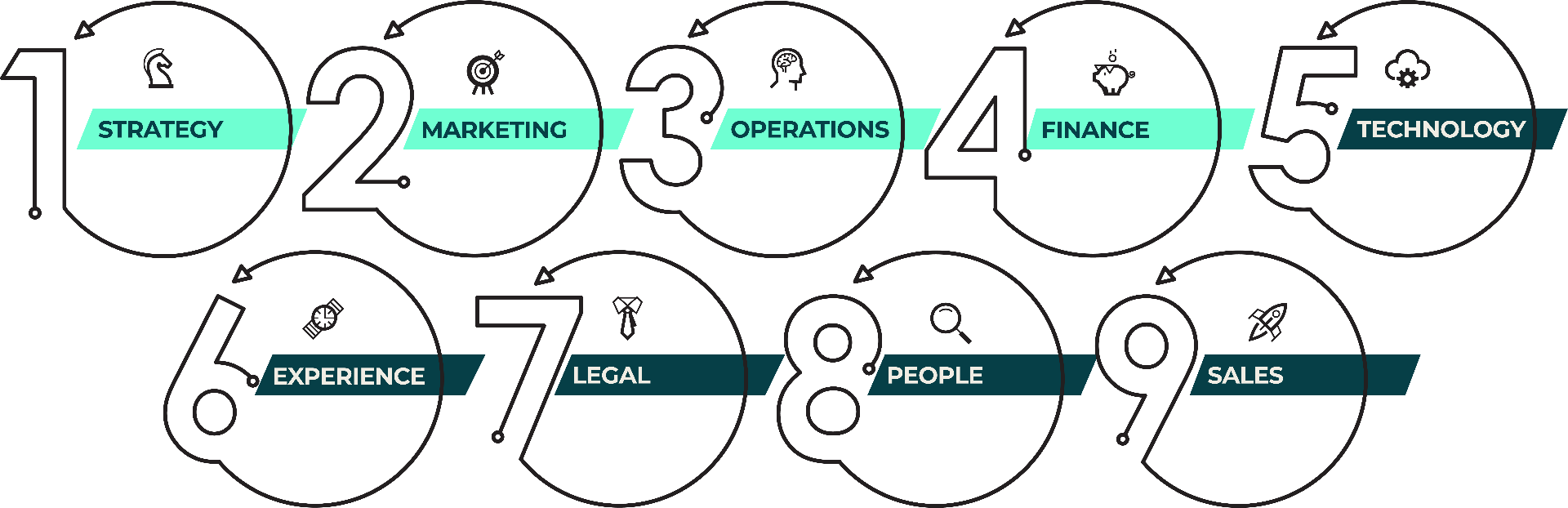
The friction often lives between dimensions, not inside one of them.
A decision system, not a report for the shelf.
Momentum Read
What movement the company is trying to create and what the operating system must support.
Nine-Dimension Operating Read
A structured read across the nine dimensions, with focus on the structural spine and critical dependencies.
Friction Map
The relationship between Momentum, Business Frictions, Tactical Pains, root causes and impact.
Root-Cause Read
An explanation of why visible symptoms are occurring and what conditions sustain them.
Recommended Intervention Path
The recommended path, its sequence and the reasoning that makes it more appropriate than the alternatives.
Intervention Magnitude
The scope, complexity, dependencies, effort, coordination and level of specialisation required.
Executive Operating Brief
A management-level synthesis of what is happening, why it is happening and what decisions should follow.
What leadership should know before starting.
No. Diagnosis does not certify compliance or inspect departments in isolation. It builds an operating read connecting strategy, execution and evidence.
No. Discovery exists to understand the company transversally and determine where greater depth is required.
Leadership receives a prioritised friction map and a decision framework. From there, the next step may be Operating Scale-Up, Growth Engine or a focused intervention defined together.
THE FIRST READ
Give us enough context to understand what is really happening.
Answer a small number of structured areas about the company's Momentum, the visible pains and the operating context. This will help Surfingvest separate symptoms from possible underlying friction before continuing the conversation.
7 SHORT AREAS · APPROXIMATELY 5–8 MINUTES
The information shared will be treated confidentially and used only to review the situation and prepare the next conversation.
Request a first read
Bring clarity to what is really happening.
A focused conversation to understand the symptoms, the uncertainty and the decisions currently being blocked.
Share the company moment, visible pains and operating context so that Surfingvest can review the situation before continuing.